Money Clarity

    Unyfy vs other expense trackers: what each can show you

    Most expense trackers answer one question: where did the money go. It is a useful question, and it is only half of the job. The other half is what that spending says about the products you are already paying for: the credit card that earns little on what you actually buy, the loan priced at a rate you would not be offered today, and the brands you pay full price at every week.

    Those three are not hidden in some separate account. They are in the same transactions a tracker already reads. A list of spends shows the money leaving; it does not show the money that could have stayed. This page compares five kinds of tracker on what each one can see, then works through one person's year to show what complete data turns up that a list alone does not.

    Last reviewed 2026-10-10

    Listing spends is only the first half

    The technique

    Ask what the data can decide, not what it can display

    A chart of categories is the output most trackers stop at. The same transactions, matched against card reward rules, loan rates and brand prices, answer three questions that a chart cannot: is this card right for me, is this loan priced fairly, and am I paying more than I need to at the same shops.

    Take Kabir, a salaried professional in Bengaluru, used as a worked example on this page. His credit card carries ₹14,650 of spending a month, ₹1,75,800 a year. He has a personal loan with ₹2,40,000 outstanding at 16 percent and 34 months left. He spends about ₹6,000 a month at large brands: food delivery, groceries, shopping and rides.

    Any tracker that sees his accounts can tell him he spent ₹14,650 on the card last month. That is where most stop. The same data, read one step further, says three more things. His card earns ₹1,578 a year in rewards, and a card matched to his spending would earn ₹6,238 after its fee, ₹4,660 more. His loan will cost ₹15,772 more in interest than the same loan at 12 percent, ₹10,108 more even after the cost of switching. And buying his usual brands through discounted vouchers at a typical 7.5 percent would keep ₹5,400 a year.

    That is ₹10,060 a year from the card and the brands, and ₹10,108 over the remaining life of the loan, none of it from spending less. The figures are illustrative, built on round numbers so they can be checked line by line. The method is the point: each of the three needs the full picture of what you spend, which is why it belongs in the same place as the tracking.

    Kabir's year, read one step further
    Card rewards he earns today
    ₹1,578 a year
    Rewards on a card matched to his spending, after a ₹500 fee
    ₹6,238 a year
    Extra from the matched card
    ₹4,660 a year
    Typical voucher discount on ₹6,000 a month at brands
    ₹5,400 a year
    Card and brands together
    ₹10,060 a year
    Loan: extra interest at 16 percent vs 12 percent, after switching costs
    ₹10,108 over 34 months

    Illustrative example with round figures and illustrative reward rates, not a specific card or lender. Redo each line with your own statements using the methods below.
    Five kinds of tracker and what each can see

    The technique

    Judge a tracker by its inputs

    Every feature a tracker offers is limited by what it can see. A tracker that sees one bank cannot tell you about a card from another, and a tracker that depends on typing sees only what was typed. Compare the inputs first; the features follow from them.

    There are five common ways people in India keep track of spending, and they differ less in their screens than in what reaches them.

    A manual-entry app records what you type. It can be as accurate as you are disciplined, and it is the only option that captures cash as you spend it. Your bank's own app sees that bank's accounts and cards in full, and nothing at any other bank. A payment app's history shows the payments made through that app, so UPI paid through a second app, card swipes and NACH debits for EMIs and SIPs are outside it. A spreadsheet is whatever you build: flexible, private and exactly as complete as the hours you give it.

    Unyfy reads the transaction alerts your banks and card issuers already send, by email and, on Android, by SMS. That puts every account whose alerts reach you in one list, with no typing, and a payment reported by both SMS and email counted once. Because the list is complete, it can do the second half of the job on the same data: match your spending to cards, price your loans against today's market and find the brands where a discount applies.

    Kind of trackerWhat it seesWhat it needs from you
    Manual-entry appOnly what you type, including cashAn entry for every payment
    Your bank's appThat bank's accounts and cardsNothing more, for that one bank
    A payment app's historyPayments made through that appNothing more, for that one app
    A spreadsheetWhatever you enter or importBuilding and updating it
    UnyfyEvery bank and card whose alerts reach youPermission to read those alerts
    Describes what each kind of tracker reads by design, not any particular app.
    • The most common gap is not a missing feature but a missing account: one card at another bank or EMIs on NACH can hold a large share of the month and never reach a single-bank or single-app view
    • Typing every payment works for some people as a discipline. If that is the goal, a manual tracker is the right tool, and the analysis on this page can still be done by hand once a month

    Know your credit card: rewards on your spends

    The technique

    Price the card on your categories, not its headline rate

    A card's headline reward rate applies to some categories and not others. What a card is worth to you is the sum, category by category, of your yearly spend times its rate there, less its annual fee.

    Kabir's current card pays 1 percent on everything except fuel, which earns nothing. On ₹1,75,800 a year that is ₹1,578, because the ₹18,000 of fuel earns zero. It feels like a decent card. It is only decent because nothing has been compared with it.

    Now price a card built for how he spends. Say it pays 10 percent on food delivery, 5 percent on online shopping and 1 percent elsewhere, with nothing on fuel and a ₹500 annual fee. His ₹36,000 a year on food delivery earns ₹3,600 instead of ₹360. His ₹48,000 of online shopping earns ₹2,400 instead of ₹480. Groceries, bills and the rest earn the same on both. The total is ₹6,738, or ₹6,238 after the fee, ₹4,660 a year more than the card he holds.

    The headline rate on its own would have misled him either way. A card advertising 5 percent everywhere sounds better than 10 percent on one category, until you notice that most of his spending is not in that category. The only fair comparison is his own split, multiplied out.

    CategoryYearly spendCurrent cardMatched card
    Food delivery₹36,000₹360₹3,600
    Online shopping₹48,000₹480₹2,400
    Groceries₹30,000₹300₹300
    Bills₹12,000₹120₹120
    Other₹31,800₹318₹318
    Fuel₹18,000₹0₹0
    Rewards, before fee₹1,75,800₹1,578₹6,738
    Illustrative reward rates, not a specific card. Real cards add caps, exclusions and point values; read the card's own terms before applying.
    • Check the cap: a 10 percent category often stops after a monthly limit, and spending above it earns the base rate, so price the capped amount, not the whole category
    • A card is only worth comparing if you would be approved for it, so filter by the income the issuer asks for before you fall for the rewards

    Are you overpaying on a loan you already have?

    The technique

    Price the interest left, then subtract the cost of moving

    A lower rate is only a saving if the interest it removes over the remaining tenure is larger than the processing fee and GST paid to switch. The fewer months left, the less a rate cut is worth.

    Kabir's personal loan has ₹2,40,000 outstanding and 34 months to run at 16 percent. His EMI is ₹8,825, and the interest still to pay is ₹60,066. A lender offering the same tenure at 12 percent would set the EMI at ₹8,362, ₹464 a month lower, and the interest left at ₹44,294. The gap is ₹15,772.

    Switching is not free. A processing fee of 2 percent is ₹4,800, and GST at 18 percent on it adds ₹864, so moving costs ₹5,664. The saving that survives is ₹10,108. That is worth an afternoon of paperwork.

    Run the same loan with 10 months left and the answer flips. The extra interest at 16 percent over those months is ₹4,553, which is less than the ₹5,664 it costs to switch, so moving would lose ₹1,111. On these numbers switching starts to pay at about 13 months left. The rate gap is the headline; the months left decide it.

    Switching a ₹2,40,000 loan with 34 months left
    Interest left at 16 percent
    ₹60,066
    Interest left at 12 percent
    ₹44,294
    Extra interest at the higher rate
    ₹15,772
    Processing fee 2 percent plus 18 percent GST
    ₹5,664
    Saving after the cost of switching
    ₹10,108

    Reducing-balance EMIs, illustrative rates and fee. The new lender sets the actual rate and fee after its own checks.

    • Ask for the foreclosure terms of the current loan too: a foreclosure charge adds to the cost of moving and can erase a small saving
    • Keep the tenure the same when you compare. A longer new tenure lowers the EMI and can raise the total interest, which is the opposite of the point

    Discounts at the brands you already use

    The technique

    Discount the spending you will do anyway

    A discount only saves money on a purchase you were going to make. Spending at the same few brands every month is the one place a voucher discount is close to pure saving.

    Most households spend a steady share at the same handful of brands: one food delivery app, one or two grocery services, one shopping site, one ride app. Kabir's is about ₹6,000 a month, ₹72,000 a year. He was going to spend it regardless.

    Buying the same purchases through discounted gift vouchers changes the price, not the habit. At a typical 7.5 percent, ₹6,000 a month keeps ₹450, and ₹5,400 over the year. The discount varies by brand, so the honest way to estimate it is brand by brand from your own statements, not from the best rate on offer.

    The first step is the list itself: which brands you actually spend at, and how much at each. Most people underestimate it, because a dozen ₹400 orders do not feel like ₹4,800.

    • Only count brands you would buy from anyway. A voucher for a brand you rarely use is a prepaid balance waiting to expire, not a saving
    • Check the voucher's validity and whether it can be used together with the brand's own offers before buying it for a large order

    What complete spending data also shows

    Once every account is in one list, a few other questions answer themselves. What is next month already committed to, before the salary arrives: EMIs, SIPs, rent, bills, subscriptions and the card bill. What a trip or an event really cost, kept apart from ordinary months. Which income is salary and which is refunds, interest or transfers, so a refund is not mistaken for a raise.

    None of these needs a new habit. They need the same complete list, read with a different question in mind. That is the real difference between trackers: not how the chart looks, but how many questions the data underneath can answer.

    • Committed spending first: the money already spoken for is the number that decides whether the rest of the month is comfortable
    • Keep trips and events separate, or one expensive month makes the next three look like savings

    When a simpler tracker is enough

    Not everyone needs all of this. If you have one bank account, no credit card and no loans, your bank's own app already sees everything that matters. If most of your spending is in cash, a manual tracker that you fill in as you spend will be more complete than anything that reads bank records. And if typing each expense is the habit you are trying to build, the act of logging is the benefit.

    The case for reading every account changes as soon as there is a second bank, a credit card or an EMI. That is when the questions on this page start to carry real money, and when a list from one bank or one app stops being the whole picture.

    • One account and no credit: your bank's app is enough
    • Several accounts, a card or a loan: the card, loan and brand checks above are where the money is, and they need every account in one place

    How Unyfy helps you see all of it

    Unyfy reads your bank and card transaction emails and, on Android, your bank's SMS, so every account whose alerts reach you lands in one list with no typing. It never asks for your bank password or UPI PIN, and every payment made through it is one you authorise.

    On that list it does the second half of the job. Your category spending is matched against 605 credit cards from 32 issuers, filtered to the ones your income qualifies for, with the yearly rewards each would earn after its fee, and you can apply in the app. Each loan on your credit report is shown with its rate and interest still to pay, flagged when it is priced above what banks offer today, with offers from 15+ banks and NBFCs that show whether switching pays after the fee. The brands you spend most at are listed with discounted vouchers, typically around 7.5 percent and up to 30 percent on some brands with Pro.

    Tracking, card match, loan checks and vouchers are free. Pro at ₹99 a month adds Fixed Expenses with subscriptions, unlimited Ask Unyfy questions and voice, and a higher voucher discount. Every feature is on the features page. Install Unyfy on Android, or use the web app at app.unyfy.co.in on an iPhone.

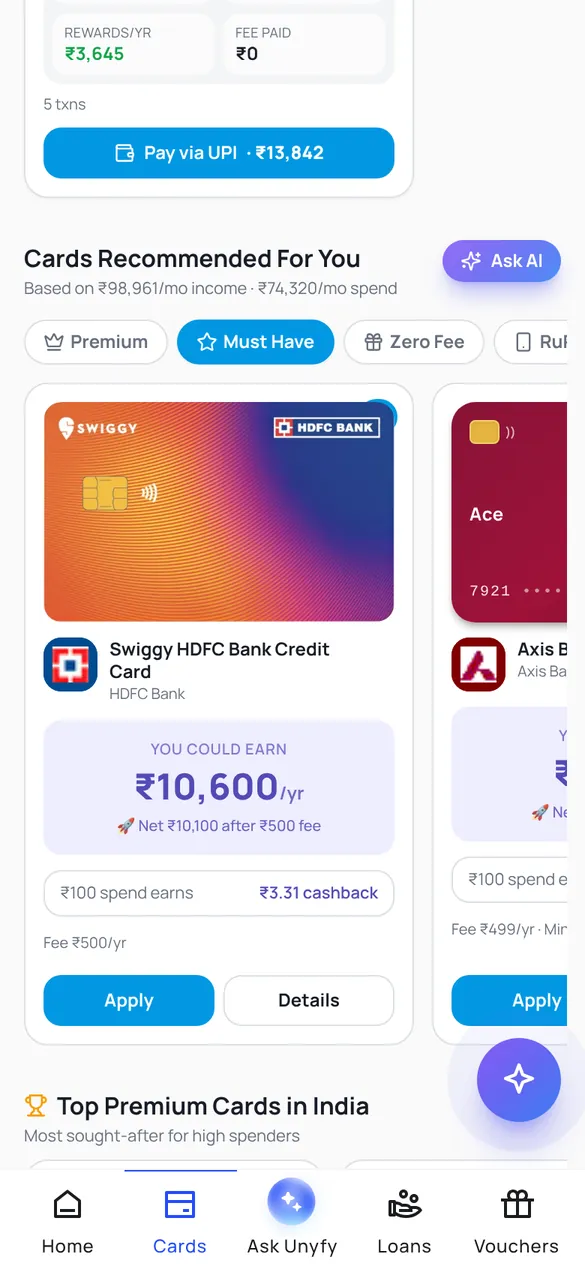
    Cards recommended for you, showing a card with the yearly rewards it would earn on the user's spending after its fee

    1.The right card for your spending

    Cards matched to what you spend, with the yearly rewards after the fee.

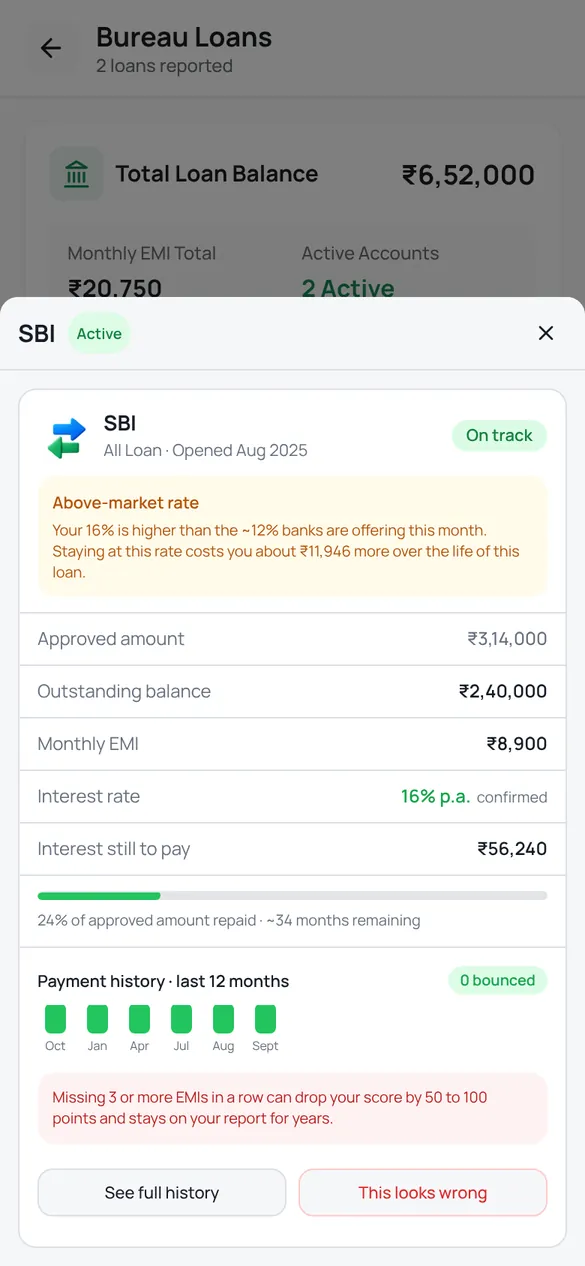
    Loan detail sheet flagging an above-market interest rate with the extra cost, outstanding balance and payment history

    2.Loans priced above the market

    A loan flagged when its rate is above what banks offer today.

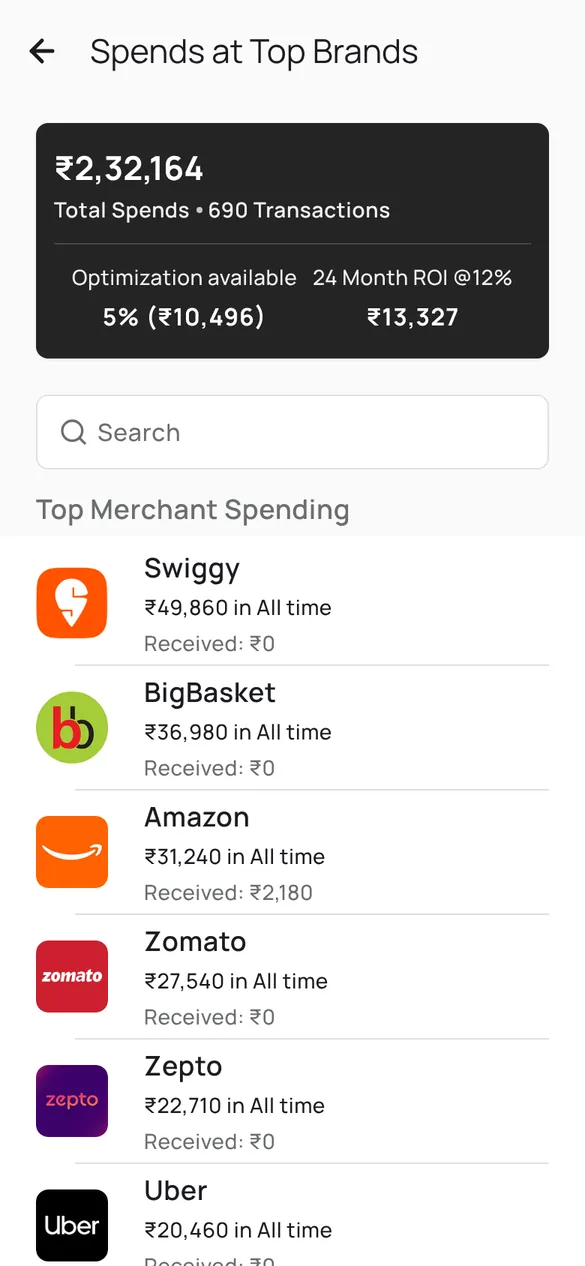
    Spends at top brands screen listing the brands spent at most, with totals and refunds received

    3.Top brands and vouchers

    The brands you spend most at, where a voucher discount applies.

    App screens with sample data for a sample user, not the worked example on this page.

    Common questions

    Is Unyfy better than other expense trackers?

    It depends on what you want a tracker to do. A manual tracker suits someone who wants to log every expense, including cash. Unyfy reads every bank and card account whose alerts reach you, with no typing, and then uses that data to check your credit card rewards, your loan rates and your spending at brands, which a list of spends alone does not show.

    Can an expense tracker tell me if my credit card is right for me?

    Only if it knows your spending by category and the reward rules of other cards. The method is to multiply each category's yearly spend by the card's rate there, add it up and subtract the annual fee. In the worked example, a card earning ₹1,578 a year was beaten by one earning ₹6,238 after its fee, ₹4,660 more.

    How do I know if I am overpaying on my loan?

    Work out the interest left over the remaining tenure at your current rate and at the rate you would be offered today, then subtract the cost of switching. On ₹2,40,000 with 34 months left, 16 percent against 12 percent is ₹15,772 of interest, or ₹10,108 after a ₹5,664 processing fee with GST. With only 10 months left, the same switch would lose ₹1,111.

    How much can vouchers save at the brands I already use?

    Multiply your monthly spend at those brands by the discount. At a typical 7.5 percent, ₹6,000 a month keeps ₹450, or ₹5,400 a year. The discount varies by brand, so count only brands you would buy from anyway.

    Does Unyfy need my bank password or UPI PIN?

    No. It reads the transaction emails and, on Android, the SMS your bank already sends. It never asks for a bank password or UPI PIN, and every payment made through it is one you authorise.

    Is Unyfy free?

    Tracking, card match, loan checks and vouchers are free. Unyfy Pro is ₹99 a month and adds Fixed Expenses with subscriptions, unlimited Ask Unyfy questions and voice, and a higher voucher discount of up to 30 percent on some brands.

    The difference between trackers is not the chart. It is how much of your money reaches the tracker, and how many questions it can answer once it does. A list from one bank or one app shows part of the spending. A complete list, read one step further, shows the card that earns too little on what you buy, the loan priced above today's market and the brands where you pay full price, and in the worked example that came to ₹10,060 a year plus ₹10,108 on the loan, without spending less on anything. Whatever you use, run the three checks on this page once with your own statements: rewards by category, interest left against today's rate, and your spend at the same few brands.

    Our Partners

    Banks and NBFCs we compare

    Unyfy compares offers from these lenders and earns a commission if you take one. The comparison is shown first, and it can tell you not to switch.

    HDFC Bank logo
    ICICI Bank logo
    Axis Bank
    State Bank of India logo
    IDFC First Bank logo
    Kotak Mahindra logo
    IndusInd Bank logo
    Yes Bank logo
    Bajaj Finserv logo
    Tata Capital logo